
Outdoor Cushions That
Fade or Stay Wet:What to Check Before Buying
A faded cover and a waterlogged cushion need different remedies. Before replacing either, check the fabric, the filling and the less visible layers that determine whether your next set will work on your patio.
In this article
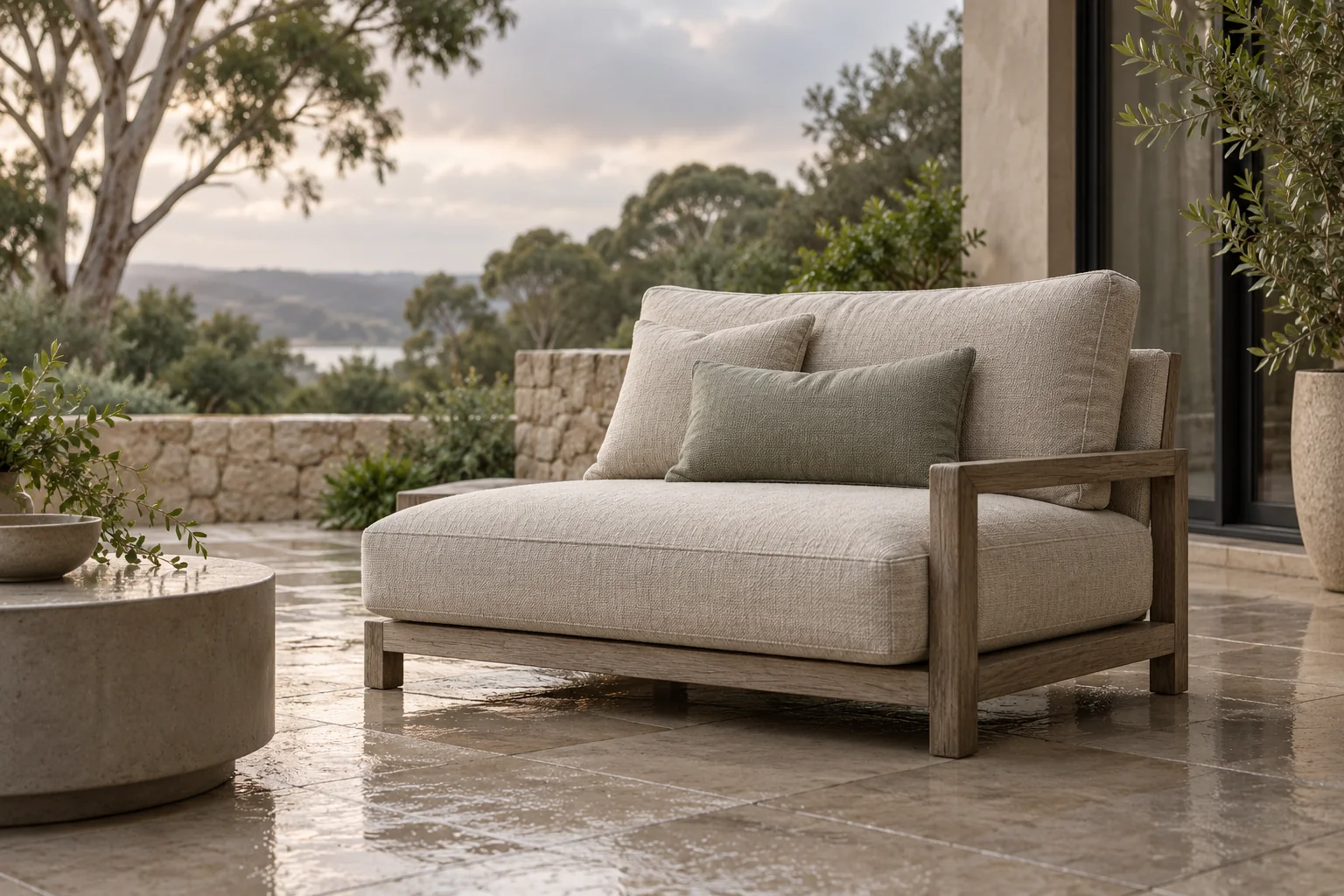
An outdoor lounge can reach an awkward point: the frame is still worth keeping, but the cushions make it unpleasant to use. The colour has washed out, the seats remain damp after rain, or the inserts no longer hold their shape.
Replacing the whole lounge is one option. Often, the more useful question is which part of the cushion needs replacing, and whether the replacement addresses the original problem. A better-looking cover can leave you with the same wet seat underneath.
Start with two separate requirements: evidence that the chosen fabric will resist fading, and a complete cushion construction suited to the water it will encounter. Neither requirement can be answered by an “outdoor” label alone.
Ask about the fabric.
Exact fabric name, colour code, composition and lightfastness result—including the test method.
Separate fading from dryingAsk about the whole assembly.
Core, liner, wrapping, seams, zip and underside. How can water and air leave?
Follow the waterWork out what you need to replace
Inspect the cover and, where the furniture instructions allow access, the insert separately. Is the surface dirty, faded or torn? Is the filling misshapen? Has the thin inner casing deteriorated? Does the cushion repeatedly remain wet inside?
If the problem is dirt, try the approved cleaning method before ordering replacements. If only the cover has failed and the insert is dry, supportive and compatible, a cover replacement may be enough. Persistent wetness or a damaged insert calls for a closer look at the filling and its casing.
IKEA's 62 × 62 cm FRÖSÖN/DUVHOLMEN combination illustrates the value of separate parts. In Australia, the beige FRÖSÖN cover is listed at A$25 and the DUVHOLMEN insert at A$45. Together, they cost A$70. Those prices buy different components, allowing you to replace the part you need.[1]
That is a useful purchasing model, rather than a universal fit recommendation. Check the dimensions and construction against your own furniture. IKEA specifies a polyurethane core, polyester filling and polypropylene inner casing for this insert; it does not identify it as a reticulated quick-dry core.[2]
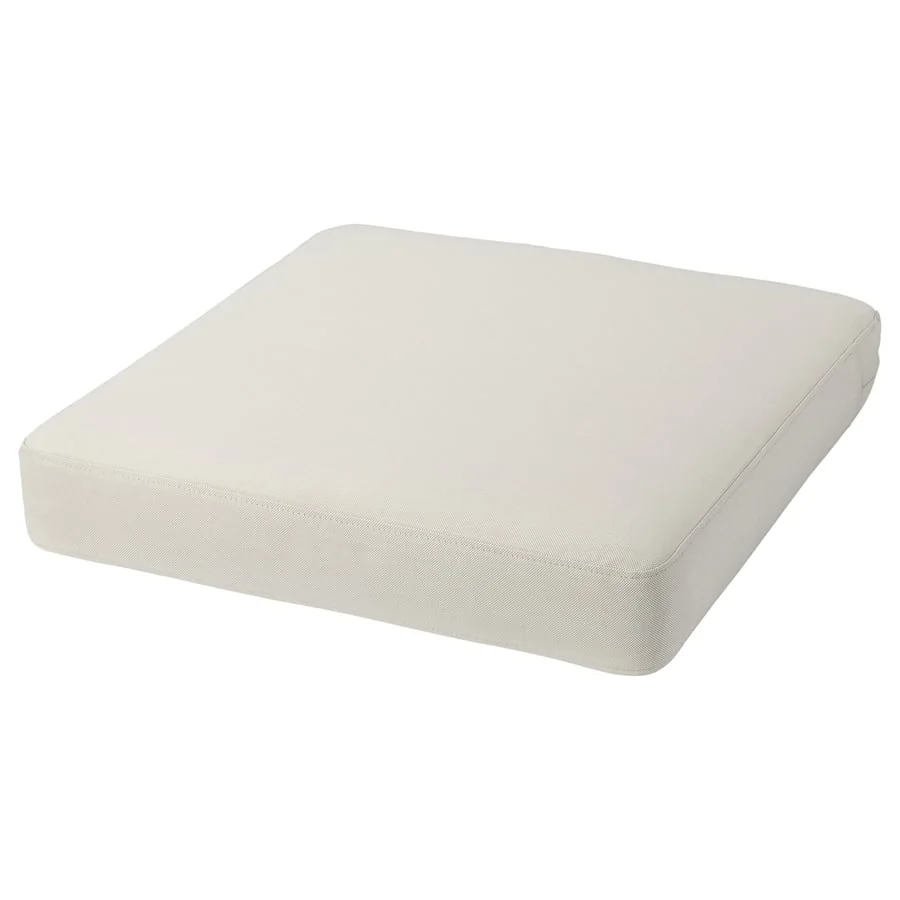
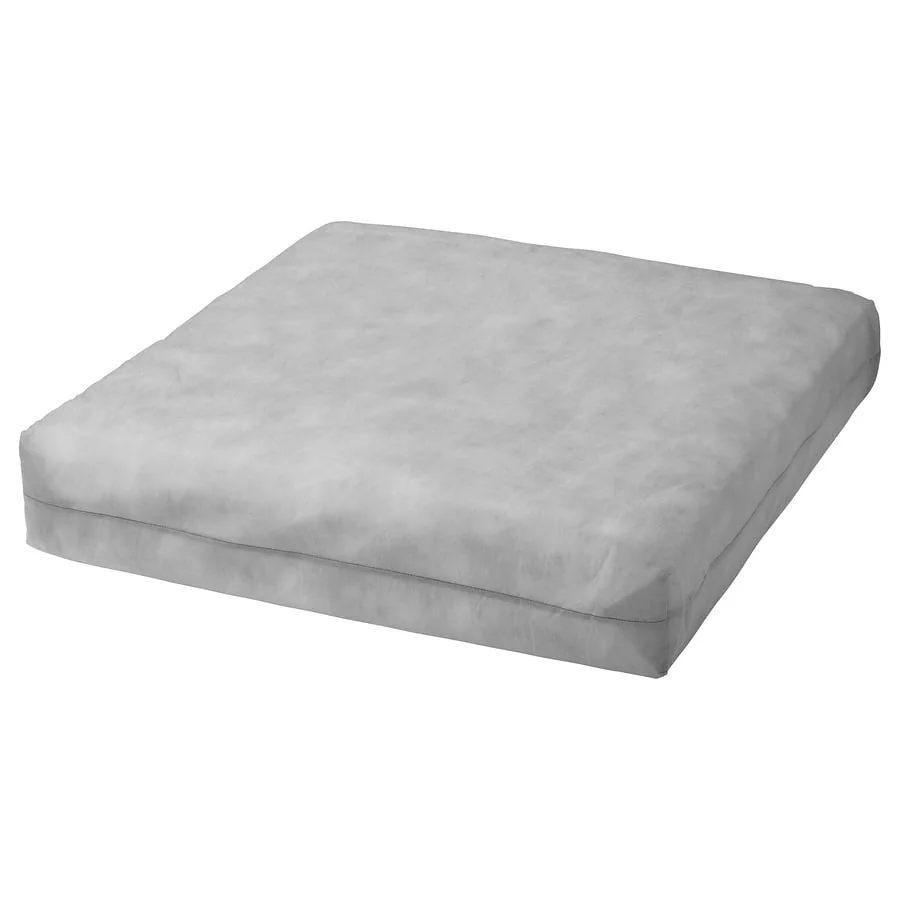
A$70 together. A model for replacing separate parts—not a universal fit recommendation or a reticulated quick-dry specification.
Separate fading from drying
Fabric specifications can look reassuring while answering the wrong question. Abrasion resistance describes resistance to rubbing. Lightfastness concerns colour change under light exposure. Neither tells you how long a soaked cushion will take to become usable.
Warwick's 2024 SUNDEC brochure makes the distinction visible. Its Rottnest fabric, specified as 88% recycled olefin and 12% recycled polyester, lists 70,000 Martindale abrasion cycles separately from lightfastness above 7 under ISO 105-B02.[3]
88% recycled olefin
12% recycled polyester
Neither figure tells you how long a soaked cushion takes to dry.
The lightfastness result is relevant evidence for that fabric. The abrasion figure answers a different question. Neither figure is a promise of a particular number of years on an Australian terrace, and the brochure should be checked against the current collection and colour before ordering. ISO 105-B02 is an artificial-light test using a xenon arc lamp.[4]
For faded cushions, ask for the exact fabric name, colour code, composition and lightfastness result, including its test method. For wet cushions, ask how the complete cushion handles water. Keep those enquiries separate, even when the supplier offers one answer labelled “performance fabric”.
Look beyond the fabric brand
A recognised fabric name gives you somewhere to begin checking specifications. You still need the particular fabric and the construction around it.
Sunbrella's own guidance says its fabrics range from water-resistant to waterproof. Its cushion-design guide treats a moisture-barrier construction differently from a construction designed to let water pass through. Properties associated with a coated Rain fabric cannot simply be assigned to every cushion carrying the brand name.[5]
Ask what the supplier means by water-resistant. Is it a surface treatment that helps shed light rain, a barrier intended to limit penetration, or part of a draining construction? Then ask about seams and the zip, where the fabric specification alone leaves questions unanswered.
For colour, request a physical swatch alongside the specification. It lets you judge texture and appearance, although it cannot demonstrate long-term fade resistance. Paying for a fabric upgrade makes more sense when you know which documented property you are buying.
Paying for a fabric upgrade makes more sense when you know which documented property you are buying.
Follow the water through the cushion
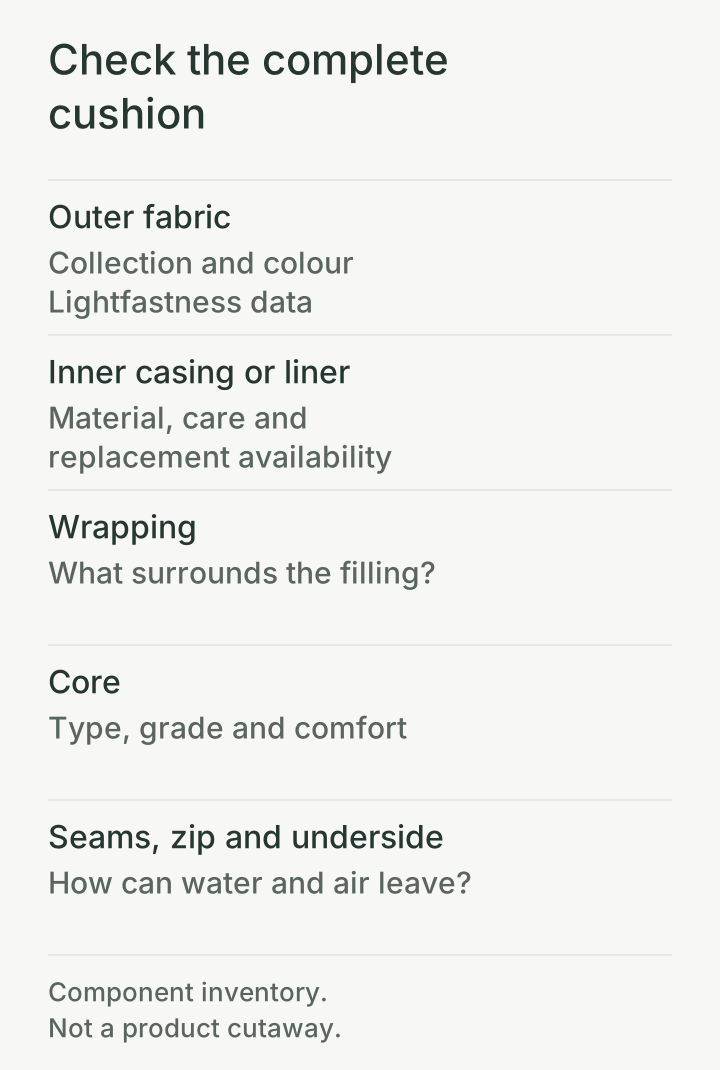
A cushion has several layers: outer fabric, an inner casing or liner, any wrapping around the filling, and the core. The seams, zip and underside also affect the construction.
Check the complete cushion
Outer fabric
Collection and colour. Lightfastness data.
Inner casing or liner
Material, care and replacement availability.
Wrapping
What surrounds the filling?
Core
Type, grade and comfort.
Seams, zip and underside
How can water and air leave?
Components to confirm with the supplier. This inventory is schematic and does not depict a featured product.
Sunbrella's design guide describes both limiting water entry and providing a route for water to leave. A barrier design needs attention to sewn holes, zip protection and ventilation. A draining design needs a suitable exit through the casing. One illustrated option uses an open-weave bottom panel and is generally intended for use on one side.[5]
For frequently wet seating, look for an explicitly reticulated core. Reticulation produces a more open structure that allows water and air to pass through. “High density” describes something else, and “open-cell” by itself is insufficient: ordinary flexible polyurethane seating foams can also be open-cell.[6]
Reticulated.
High density.
Open-cell.
For frequently wet seating, look for an explicitly reticulated core.
Outdoor Interiors offers a particularly clear example. Its Monte-Carlo-Black Sunbrella bench cushion, measuring 1,240 × 450 × 50 mm, can be ordered with either N31-35R reticulated outdoor foam or 35-150 high-density foam. The supplier describes the latter as softer and suitable for undercover conditions, with an explicit warning against leaving it in rain.[7]
The fabric remains the same while the intended use changes with the insert. That is why the filling option belongs on the order confirmation.
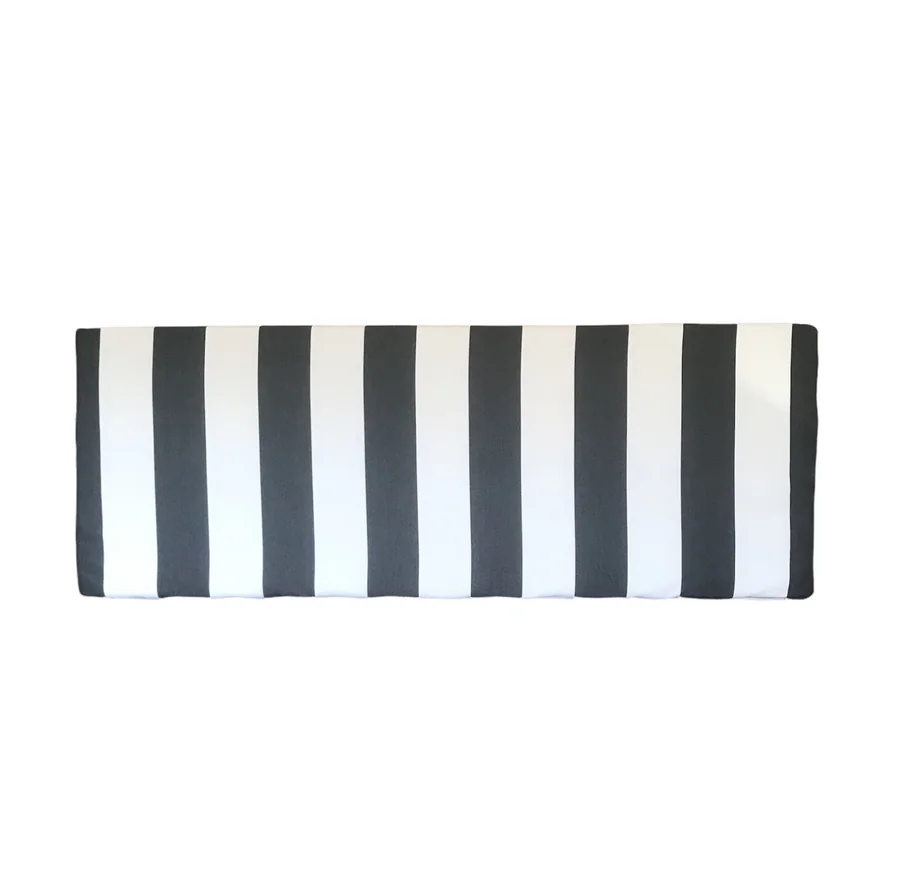
For an existing cushion, Clark Rubber's Fast Dry Foam and The Foam Booth's made-to-measure DRICELL offer routes to investigate a replacement core. Both identify reticulated foam. A cut core still needs to work with your cover, liner, wrapping and available drainage; neither listing establishes the drying time of your finished cushion.[8]
Check the layer you rarely see
The inner casing deserves as much attention as the outer fabric. It can affect whether the filling stays together when you remove the cover and whether the cushion remains practical to repair.
Cushion Factory advertises Urecel-filled outdoor cushions for continuous exposure to sun and rain. Its terms, however, say that liner-bag fabric is outside the warranty and will disintegrate if cushions are left outside in the weather. Replacement liners can be ordered.[9]
The foam’s advertised suitability does not resolve the liner’s limitation.
Those statements concern different components. Before buying that configuration for an exposed patio, ask which liner will be supplied, how it should be used and what replacement costs. The foam's advertised suitability does not resolve the liner's limitation.
Reviews on IKEA's DUVHOLMEN page also include reports of inner casings deteriorating, alongside positive accounts of comfort and fit. They are customer experiences, with varying conditions and variants, rather than evidence of an Australian failure rate.[2]
The useful lesson is to ask whether the liner is replaceable and whether its care and warranty suit the way you intend to use the cushion. An attractive outer cover can conceal a less serviceable assembly.
Confirm comfort, fit and cleaning together
Drainage cannot tell you whether you will enjoy sitting on the result. Nor can a density number alone.
Density is not hardness.
Joyce Foam's technical brochure distinguishes density, the mass of foam per cubic metre, from hardness, which describes how the foam feels under testing. Ask for both, with the test method, then consider the thickness and a seating sample where available. There is no single density figure that settles comfort for every seat.[10]
Measure the whole seat.
For fit, follow the replacement supplier's measuring instructions. Record the usable frame dimensions, seat and back thicknesses, angles, shapes and attachment points. A thicker seat can change your position relative to the backrest. Confirm how the finished dimensions account for wrapping and the cover.
A zip provides access.
Cleaning needs the same component-by-component approach. IKEA permits machine washing of the specified FRÖSÖN cover at up to 40°C, while the DUVHOLMEN insert must not be washed. Cushion House Australia advises against machine washing its custom outdoor covers and supplies cleaning instructions for the chosen fabric.[1][2][11]
Sunbrella also directs owners to consult the furniture manufacturer before removing a casing for machine washing, because cushion construction varies.[12]
A zip provides access. Before treating it as an invitation to remove everything, check whether the cover can be washed separately, whether the liner will withstand handling, and how the filling is meant to be reinserted. Obtain cleaning instructions for the assembled cushion as well as the fabric.
Decide what the extra money solves
The cheapest successful replacement is the one that fixes the actual problem while retaining serviceable parts. Custom work becomes useful when standard sizes cannot accommodate your frame, or when you need a different complete construction.
Perth Outdoor Cushions lists a custom Sunbrella chair set from A$475, including one seat and one back cushion. Its three-seater listing starts at A$1,350 for one long seat cushion and three back cushions. These are substantially different orders from a single A$70 IKEA seat cushion.[13]
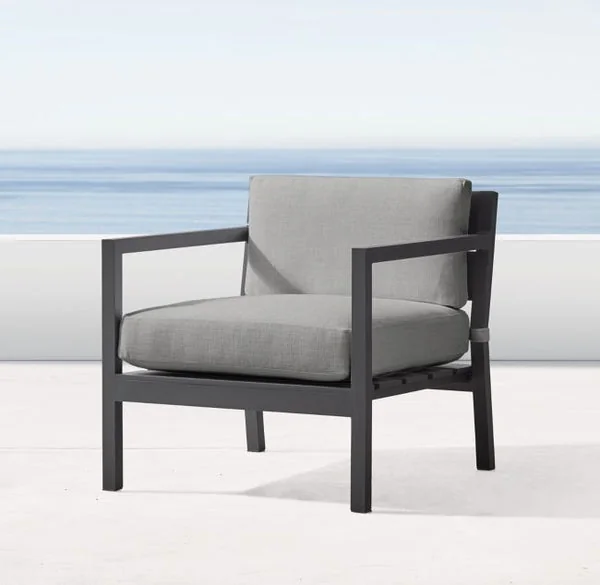
One seat. One back.
From A$475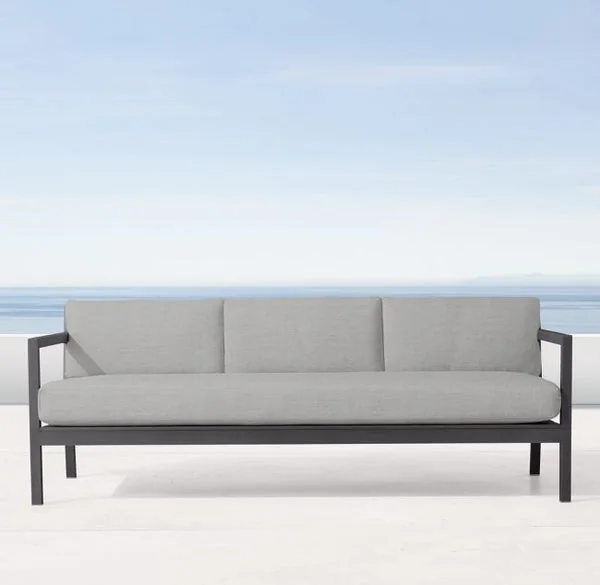
One long seat. Three backs.
From A$1,350Starting prices describe different order scopes. The photographed configurations are references, not confirmed quotations.
The Perth listings describe seating foam and polyester-fibre back inserts without establishing a reticulated construction. Confirm the water-handling details before treating either as a solution for regularly soaked seating. Both pages also display sold-out wording, so check whether your configuration can currently be ordered.[13]
Obtain the applicable warranty in writing: the three-seater page states three years for materials and workmanship, while the terms page states five years for fabric and workmanship.[13][14]
Use the replacement routes below to structure the quotation:
An upgrade should purchase a useful improvement: documented colour resistance, appropriate drainage, better fit, manageable cleaning or reliable parts supply. Include every seat and back cushion, delivery and any fitting or alteration charges in the total.
For custom orders, clarify what happens if your measurements are wrong. Perth's terms describe repair and freight charges for customer measurement mistakes. Voluntary warranties sit alongside Australian consumer guarantees; the ACCC explains that these statutory rights continue to apply.[14][15]
Get the specification before placing the order
Ask the supplier to confirm these points for your selected configuration:
Tick each point as you obtain the specification.
A cover replacement can be enough when the existing insert still works. Where persistent wetness is the problem, the new order needs to explain how the complete cushion will handle water. Where fading is the problem, it needs evidence for the chosen fabric.
Keeping a good frame becomes worthwhile when the replacement cushions make it usable again. The strongest reason to spend more is a specification that addresses what went wrong last time.
Australian listings checked 3 October 2026. Prices are in AUD and may vary with configuration and delivery. Confirm stock, made-to-order availability and the final quotation. Product examples are based on published specifications, not hands-on comparative testing.
Sources & notes
15 REFERENCES- IKEA Australia: FRÖSÖN beige cover, 62 × 62 cm. Back
- IKEA Australia: DUVHOLMEN insert, 62 × 62 cm. Published specifications and customer reviews are separate forms of evidence. Back
- Warwick SUNDEC brochure, 2024, PDF page 28. Back
- ISO 105-B02:2014: colourfastness to artificial light. Back
- Sunbrella water-resistance guidance and Designing Quick Dry Cushions. Back
- Urecel: What is UQD? and Joyce Foam technical brochure. Back
- Outdoor Interiors: Monte-Carlo-Black bench cushion. Back
- Clark Rubber: Fast Dry Foam and The Foam Booth: Outdoor Foam. Back
- Cushion Factory: outdoor foam and terms and conditions. Back
- Joyce Foam technical brochure, July 2025, PDF page 3. Back
- Cushion House Australia: custom outdoor cushions. Back
- Sunbrella upholstery care and cleaning, revised February 2025. Back
- Perth Outdoor Cushions: chair set and three-seater set. Back
- Perth Outdoor Cushions: terms and refund policy. Back
- ACCC: warranties. Back