
Buying Outdoor Furniture for a Coastal Home in Australia
A corrosion-resistant frame leaves plenty of the purchase unexplained. Before choosing furniture for a coastal balcony or garden, check the connections, cushion routine and warranty conditions that will shape life with it.
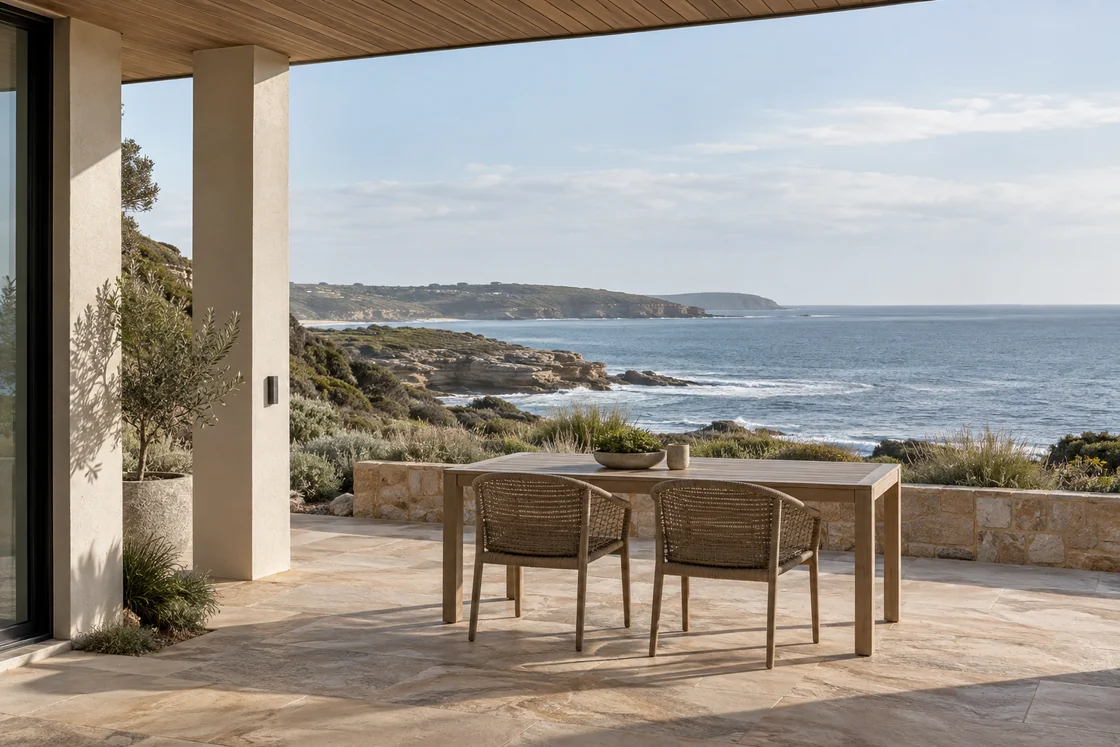
You can choose an aluminium frame and still know very little about the bolts holding it together. You can buy teak for its natural appearance, then discover that keeping its original colour demands more attention than you wanted. A long structural warranty may offer little reassurance about the finish you paid for.
For a coastal home, the useful comparison is between complete pieces of furniture, with their care instructions and conditions attached. Material matters. So does whether you can rinse the furniture where it stands, store the cushions and replace a worn component without replacing the whole piece.
The four Australian-market products below illustrate those decisions. They have not been tested by Meleus & Mosman, and the available documentation does not establish a ranking for coastal durability.
Describe the spot where the furniture will stand
Give the supplier more than a suburb or distance from the beach. Describe whether the space faces open surf or a sheltered bay, whether it receives direct spray, and where you notice salt deposits. Include photographs of the intended position and explain what shelter it has.
A roof does not settle the question. The Australian Stainless Steel Development Association, or ASSDA, explains that rain-sheltered stainless steel can accumulate salts because rain does not wash them away. Wind exposure, surface condition and drainage also affect corrosion. Its coastal corrosion guidance shows why a distance alone is an incomplete description.
Then consider access. Can you reach the underside and connections to clean them? Is rinsing practical on this balcony? Where would cushions dry after getting wet? Answer these before narrowing the choice to a particular finish.
Ask what connects the frame
Request the materials for the fasteners, brackets and other metal components, as well as the visible frame. If the description says stainless steel, ask for the grade.
ASSDA recommends grade 316, or equivalent corrosion resistance, as a minimum within five kilometres of surf. More demanding conditions can require higher grades. That is technical guidance for stainless steel, not certification that a finished chair will suit your site. Surface finish, construction and maintenance remain relevant.
Mixed metals need their own question: how are they protected at the connection? ASSDA's galvanic corrosion guidance explains that dissimilar metals can corrode when electrically connected in the presence of a conductive liquid. Suitable isolation can help manage that risk. The presence of two metals alone does not establish a defect.

Ask the supplier to explain the construction rather than replacing hardware yourself. A material substitution made without the manufacturer's advice may leave other compatibility questions unanswered.
For powder-coated furniture, look for information about surface preparation and the coating system. A colour name, or even the name of a coating supplier, leaves those details unresolved. Missing documentation is a reason to ask further questions, not proof that the product is poorly made.
Decide which changes in appearance you can live with
The golden teak in a product photograph and weathered grey teak represent different ownership choices. Lister Teak's care guidance distinguishes allowing raw timber to grey from maintaining its golden colour with treatment. Accepting that colour change does not eliminate cleaning.
Use that distinction to decide what you want, then obtain instructions for the actual furniture and finish. Another brand's teak advice is not automatically the correct routine for a Castlery Rio sofa.
Stainless steel raises a different issue. ASSDA describes tea staining as cosmetic surface corrosion. That description should not be used to dismiss every rust mark or diagnose an unknown fault.
An unchanged finish can be a legitimate requirement, particularly when furniture is chosen to match an interior. Make it explicit. Ask what the manufacturer expects the surface to look like over time and what care that expectation assumes. A structurally sound piece may still disappoint a buyer who expected its colour and finish to remain untouched.
Choose the cushion routine before the cushions
Cleaning instructions can change which furniture makes sense for a home. Harbour's care guide calls for weekly rinsing in saltwater environments across several material sections. A routine like that needs to be practical where the furniture will sit. Use the instructions for the specific product and materials; it is not a universal schedule for outdoor furniture.
Upholstery adds drying and storage decisions. Castlery describes Sierra's cushions as water-repellent. An older, publicly linked Sierra care manual, whose filename dates to 2022, states that its fabric is not waterproof and requires complete drying before covering. Its applicability to the current version needs confirmation. Request the matching manual before deciding that a cover will take care of wet cushions.
Allocate a real place for drying and storage, allowing for the full set. If that space does not exist, investigate a sling seat or furniture you are comfortable using without loose cushions. Sit in it before committing: removing a storage chore is only useful if the seat suits how you want to use it.
Four products that make the checks concrete
These examples cover upholstered aluminium, upholstered teak, a sling chair and a bench. They serve different purposes and are not directly comparable by price. Listed prices were checked on Australian pages on 3 October 2026. Confirm the selected variant, delivery charge and final order price.
| Product and listed price | What the construction offers | What to establish before ordering for a coastal site |
|---|---|---|
Castlery Sierra Outdoor 2 Seater Sofa, A$1,399 without a cover |
Powder-coated aluminium, resin wicker and upholstered cushions with removable covers. A lounge option that requires a workable cushion routine. |
Component and fastener materials, the current care manual, and written clarification of the outdoor warranty wording discussed below. |
Castlery Rio Outdoor Teak 2 Seater Sofa, A$1,989 for Natural Teak / Emma Natural Beige on clearance |
A solid-teak frame with upholstered cushions. The choice includes both timber appearance and cushion care. |
Instructions for this finish, metal hardware details, replacement covers and the same warranty clarification. Check the clearance restrictions before paying. |
Harbour Breeze Dining Chair, A$695 for Aluminum Asteroid / Batyline Silver |
Aluminium, teak arm inserts and a Batyline sling seat and back. No loose seat cushion to put away. |
Seat comfort, component materials, replacement sling cost and availability, and how the warranty applies at the intended location. |
Tait Voom Bench Seat, from A$3,159 including GST |
Aluminium and stainless-steel construction, usable without optional cushions. |
Stainless-steel grades, protection at connections and site-specific finish conditions. The listing also shows unavailable, so obtain a delivery quote and lead time. |
None of these descriptions establishes how long the furniture will last at your home. They give you a way to identify which questions remain unanswered for each construction.
Read the warranty by component and location
Start with the parts you are most concerned about. Harbour's Australian warranty table lists three years for frames and Batyline fabric, but two years for Batyline sling construction. The page also contains exclusions and differing warranty passages. Ask which terms apply to the current product, including cosmetic changes and the intended exposure.
Tait advertises a ten-year structural warranty for Australian orders dated after 1 July 2025. Its conditions include limits on decorative finishes in harsh seafront environments. Voom's coastal suitability label and the structural period therefore do not establish ten years of unchanged appearance. Request the conditions for your site and chosen finish.
Castlery's published terms need a more direct clarification. Its Australian warranty page provides an outdoor-products table, yet section 2(f) says the warranty does not apply when a product is used outdoors. Those statements conflict. The page alone does not explain how that exclusion applies to Sierra or Rio. Obtain a written answer for the exact model before treating the warranty as a reason to buy it.
This is a question about the voluntary warranty. The ACCC explains that Australian Consumer Law guarantees apply separately and cannot be taken away by warranty terms. That does not establish the outcome of a particular claim involving salt exposure.
Price the order you will actually own
The two Castlery sofas have different dimensions, construction and selling conditions. The gap between their listed prices cannot be treated as the price of upgrading from aluminium to teak. Nor can a dining chair and a bench establish a sensible spending threshold for a lounge setting.
Build the comparison around the furniture needed for the space: the right number of seats, any table, cushions, recommended protection and delivery. Check dimensions against doorways, lifts and the final position. On the Rio clearance listing, Castlery states no cancellation, return or exchange. Resolve fit and comfort before ordering; those retailer conditions do not remove statutory rights.
Then ask about the purchase after the purchase. Get prices and current availability for replacement cushion covers, slings, glides and relevant hardware. Establish who can do the repair locally and what collection or transport would involve. A general statement that spare parts are available is less useful than an identifiable part, a price and a supplier.
Those answers can justify paying more. So can a seat you find more comfortable or dimensions that fit the space properly. The available evidence does not establish a price above which coastal longevity improves, or a service-life advantage for any of these four products. Do not pay a durability premium on that assumption alone.
Get a usable answer before placing the order
Send the retailer your site description and photographs with the exact model, finish and configuration. Ask them to confirm:
- Whether that configuration is suitable for the described salt exposure, and any limits on placement.
- The materials and relevant grades of its connections and hardware.
- The cleaning, drying and storage routine required at that location.
- Which warranty provisions apply to structural problems, corrosion and changes in appearance.
- Which replacement parts can be supplied, at what current cost, and how repairs are handled.
Keep the response with the product specification and order. If the required care will not work in your home, change the configuration. If a critical suitability or warranty question remains unanswered, hold the order. Commit when you have a piece you want to use, a routine you can maintain and written conditions you understand.