
Selects / Laundry / A020
Is a Faster Premium Heat Pump Dryer Worth It for Back-to-Back Loads?
A shorter drying cycle can make a crowded laundry day easier. The premium is worth considering when a documented speed advantage brings the last load forward enough to fit your day. Start with the washing schedule, then check what the extra money buys.
In this article
Three loads are waiting, and the dryer is still working through the first. Paying more for a faster heat-pump model sounds reasonable. If it lets you finish before leaving the house, or keeps the last load from running into the evening, the benefit is tangible.
The purchase needs two checks. The dryer must be faster with the sort of laundry you put in it, at the dryness you need. That advantage must also shorten your actual laundry day. A faster machine can spend its saved minutes waiting for the washing machine to finish.
Two checks before the premium
There is no established model-by-model winner in the evidence reviewed here for several consecutive loads. The useful buying decision is whether a specific, documented improvement solves your scheduling problem at a price you accept.
Find the point where your laundry queues
For your next busy wash day, record when each load finishes washing, enters the dryer and becomes dry enough to put away. Note any time spent separating tangled items, restarting a programme or waiting to unload.
Keep capacity separate from speed. A larger drum may allow a suitable load to stay together rather than be split, but that changes the number of cycles being compared. For a speed comparison, use the same laundry and respect each programme's load limit.
Washed laundry waits
If washed laundry regularly sits beside an occupied dryer, shorter drying cycles could reduce the queue.
The dryer waits
If the dryer finishes before the next wash is ready, a speed upgrade has less scope to change the day.
Finished clothes wait
If you leave finished clothes in the machine for an hour, the first improvement may be a notification or a different routine.
Choose a practical target: three usual loads finished before dinner, for example. Then ask how much earlier a candidate dryer would get you there. You need a finishing time that solves a problem, rather than the shortest advertised programme.
Compare the same load at the same dryness
Drying time needs context. CHOICE uses a defined 3.5 kg dry-weight load in its clothes-dryer testing and measures time, energy use and remaining moisture. Its testing also distinguishes normal laundry from bedding performance. Energy-label testing uses a different, full-capacity load, so those figures should not be treated as interchangeable results.[1]
A fair comparison needs the same fabric mix, dry laundry weight, starting moisture and intended end dryness. Record the programme and any speed setting, along with room conditions and whether the machine started cold or followed another cycle. A published single-cycle result should be described as such.
Ask for the final moisture result as well as the minutes. A cycle that ends earlier but leaves items needing another round may offer little useful advantage. Likewise, a towel load and a small load of thin synthetic clothing answer different questions.
Quick 40A small-load claim
Bosch describes the WQG24201AU's Quick 40 programme as suitable for a small quantity of synthetic fibres and thin fabrics. It does not establish a 40-minute drying time for a full drum of ordinary family laundry.[2]
When a retailer quotes a fast cycle, ask which textiles, weight and dryness setting produced it. For consecutive loads, ask whether the result was repeated after the first cycle. A recognisable feature name is not a substitute for those conditions.
Read the speed claim before paying the premium
Miele's Australian TWD640WP data sheet gives EcoSpeed a specific comparison: 20 minutes less drying time than Miele dryers without EcoSpeed, with the same load size and energy-efficiency class, tested in the Cottons programme at full load.[3]
That is a more useful claim than an unexplained promise of fast drying. Its limits still matter. The sheet does not name a current Australian reference model or provide a series of consecutive-load results. It cannot establish a 20-minute advantage over a particular Bosch, or guarantee an hour saved across three loads.
The Australian prices below show why the feature deserves checking before you move further up a range.
| Australian model | Published price | What it contributes to this decision |
|---|---|---|
| Bosch WQG24201AU, 9 kg | AUD 1,499 | A lower-priced heat-pump reference with AutoDry. Its Quick 40 claim has a small-load scope. |
| Miele TWD640WP EcoSpeed&9kg, material number 12704900 | AUD 2,699 | A premium candidate with the documented EcoSpeed comparison. |
| Miele TWH780WP, 9 kg, material number 11905900 | AUD 3,199 | A further AUD 500 buys another model with EcoSpeed and additional features including SilenceDrum. |
Prices are the displayed Bosch and Miele Australian offers checked on 12 October 2026, before any additional installation or accessory costs. They are price references, not a controlled performance comparison.[2][4][5]
AUD 500
More does not establish faster
Both Miele examples already have EcoSpeed. The additional AUD 500 for the TWH780WP does not, by itself, establish another speed gain. Nor does the shared feature prove identical performance. If speed is your reason for spending more, ask what measured improvement the particular upgrade adds.
Quietness, controls or fabric-care options may justify a purchase on their own merits. Price them as features you want rather than folding them into an unverified claim of a shorter laundry day.
Count the minutes saved across the whole day
You can assess a documented cycle advantage with a simple schedule. Each load starts when both the washed laundry and the dryer are ready. Add its drying time, required handling and any further drying before calculating the next load's start.
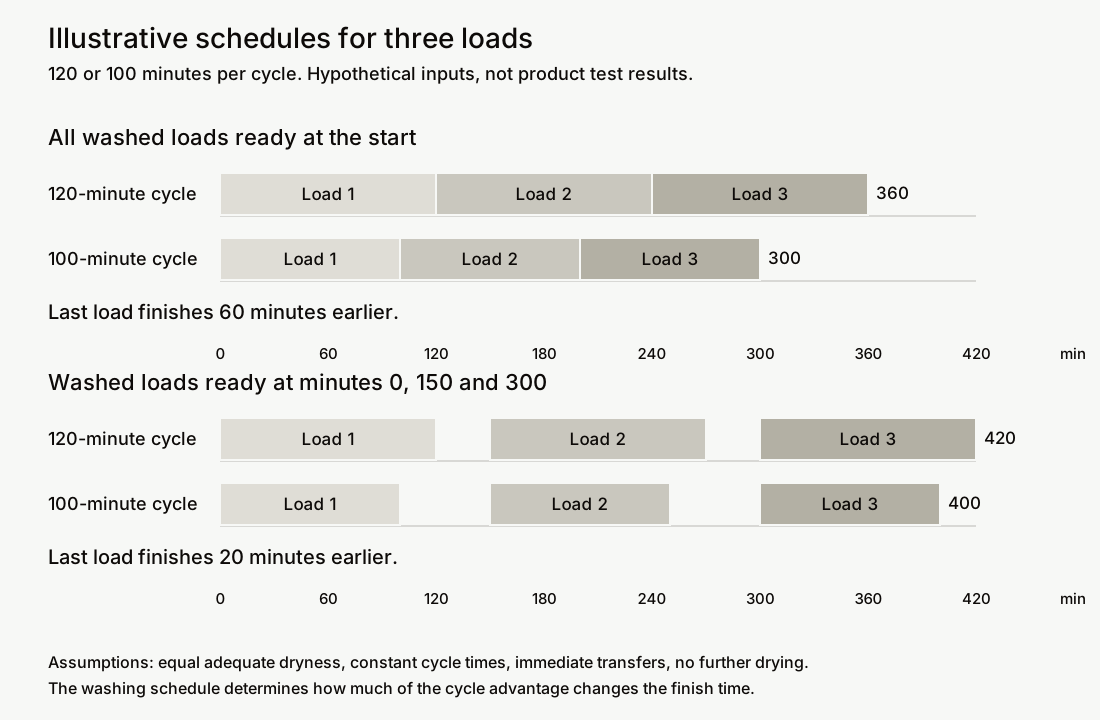
Consider two hypothetical dryers taking 120 and 100 minutes per load. These are illustrative inputs, not test results for any named model. Assume every load reaches the same adequate dryness, the cycle times stay constant, transfers are immediate and no further drying is needed.
All three washed loads are ready at the start
All loads ready at the start: 360 versus 300 minutes. The day ends 60 minutes earlier.
Hypothetical inputs, not product test results. Equal adequate dryness · Constant cycle times · Immediate transfers · No further drying. Both rows use the same 0–420 minute scale.
In the second schedule, both dryers wait for the next wash. Only the shorter final cycle brings the end of the day forward. Counting 20 minutes three times would overstate the benefit for that routine.
Real consecutive-cycle times may differ, and handling or damp items can change the schedule. Use measured values where available. If you only have one published cycle time, treat a repeated-cycle calculation as a conditional estimate and allow for that uncertainty before paying for a tight deadline.
Read both illustrative schedules as data
| Illustrative schedule for three loads | 120-minute dryer finishes | 100-minute dryer finishes | Day ends earlier by |
|---|---|---|---|
| All three washed loads are ready at the start | 360 minutes | 300 minutes | 60 minutes |
| Washed loads become ready at minutes 0, 150 and 300 | 420 minutes | 400 minutes | 20 minutes |
View the original schedule illustration
Price the improvement you will use
At the checked prices, the TWD640WP costs AUD 1,200 more than the Bosch reference; the TWH780WP costs AUD 1,700 more. Those differences buy whole appliances with different features. They cannot be assigned entirely to speed without a suitable performance comparison.
Decide how much a reliably earlier finish is worth to you. Someone who must complete several loads before an evening shift has a different constraint from someone who can leave the last cycle running while at home. Occasional use gives fewer opportunities to benefit from a speed upgrade.
For a comparison supported by evidence, divide the additional purchase cost by the finishing-time hours you expect to save over a period you choose. State the number of laundry days and the assumed saving per day. The result is a personal cost per saved hour, not proof of financial payback or a prediction of the appliance's lifespan.
Check energy consumption in the setting you intend to use. A favourable annual label figure does not supply the energy cost of every faster setting. Add the quoted delivery, installation, stacking kit, disposal and any optional cover to your purchase comparison. Ask about local service and replacement-filter availability without assuming repair costs that have not been quoted.
Check the setup, then choose
Before relying on a speed claim, check that your laundry can accommodate the model's installation requirements. Space, ventilation, drainage and access for routine care belong in the purchase decision.
Miele's Australian TWH780WP manual identifies damp incoming laundry, clogged filters, overloading, rolled-up items and a warm room among possible causes of extended drying. It also requires cleaning the fluff filters after each drying programme. A protected heat exchanger does not remove the remaining care tasks.[6]
Ask the seller for the exact Australian model code, test programme, load weight, starting moisture, final dryness and energy use behind the quoted time. For a busy wash day, request results for consecutive cycles or make clear that you are assessing a conditional schedule.
Your purchase checks
Paying more for speed is reasonable when that evidence shows a useful earlier finish for your normal loads and the extra cost fits your priorities. If the evidence only covers a small express load, or the next wash keeps both machines waiting, keep the speed premium out of your budget until you can connect it to the problem you are buying the dryer to solve.
Research and Australian price check: 12 October 2026. Product examples are based on published information. Meleus & Mosman has not conducted hands-on or consecutive-load testing of these dryers.
Sources & research notes
- CHOICE, How we test clothes dryers. Test method and differences from energy-label testing; this is not a set of comparative results for the models in the price table.
Return to test conditions ↑ - Bosch Australia, WQG24201AU. Australian model, displayed price, AutoDry and the scope of Quick 40.
Return to Quick 40 ↑Return to prices ↑ - Miele Australia, TWD640WP data sheet, material number 12704900. Manufacturer's EcoSpeed claim and full-load Cottons comparison conditions.
Return to EcoSpeed ↑ - Miele Australia, TWD640WP EcoSpeed&9kg. Displayed Australian price and exact variant.
Return to prices ↑ - Miele Australia, TWH780WP, material number 11905900. Displayed Australian price, EcoSpeed and SilenceDrum.
Return to prices ↑ - Miele, TWH780WP Australian operating instructions. See energy-saving tips, cleaning and care, and the long-drying troubleshooting guidance.
Return to setup & care ↑