
Buying a Dryer for Sheets and Quilt Covers: What to Check Before You Buy
A dryer that handles everyday clothes can still leave bedding wrapped around a damp centre. Before replacing it, check the intended bedding load, the programme limits and the evidence behind the promise of less untangling.
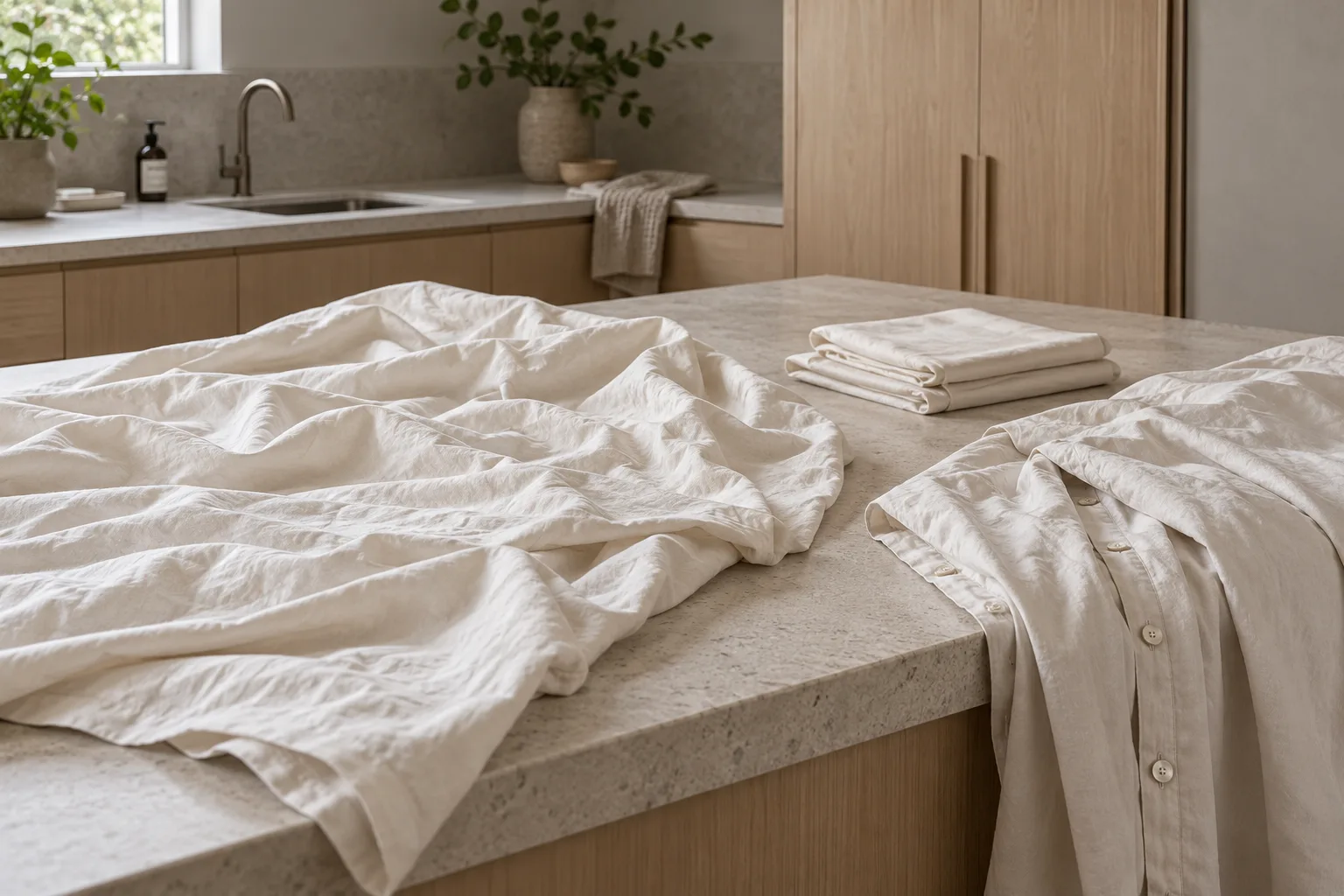
If you are buying a dryer because you are tired of opening the door to a tightly bundled sheet, the useful outcome is specific: your bedding reaches the dryness you need with fewer interruptions. A bigger drum or a more expensive machine may be worth considering, but neither tells you how often you will have to stop and rearrange that load.
Start with the bedding you own. A cotton queen sheet set, a king quilt cover and a filled doona are different loads. A product page that says it handles “bedding” may be referring to only one of them.
In this article
Describe the load you want to dry
Write down the bed size, fabric and pieces you normally wash together. Include the fitted sheet, flat sheet, pillowcases and empty quilt cover. Check their care labels before choosing a machine or programme. If your bedding requires line drying, follow that instruction when planning your laundry routine.
Then decide what you expect to put through in one run. Drying a cover separately may be acceptable if it removes the need to supervise the machine. If you need the complete set finished together, keep that requirement visible when comparing models. Ask about that exact combination rather than accepting a general assurance that the dryer is large enough for a family.
Be clear about the symptom you want to avoid. A tangled load that is evenly dry is different from a bundle with damp corners. Record whether your current routine involves splitting the load, untangling during the cycle or starting another programme. Those are the jobs an upgrade needs to reduce.
Separate sheets, quilt covers and filled quilts
An empty quilt cover is a fabric enclosure. A quilt or doona contains filling. Programme names can blur the distinction, particularly when “Duvet” and “Bedding” sit beside one another on the dial.
The Bosch WQG24201AU manual, for example, describes its Quilt/Duvet programme for items filled with synthetic fibres, with a maximum load of 2.5 kg. That is a specific use instruction; it does not establish how a cotton cover will perform in the machine.1
Fisher & Paykel's DH9060P2 manual puts sheets, pillowcases and duvet/doona covers under its Sheets guidance. It also instructs owners to fasten the openings of covers before drying.2 This is useful information to look for in any candidate's manual, even if that particular model is unavailable when you shop.
Read the programme description as well as the name. Ask which setting the manufacturer specifies for an empty cover, what its load limit is and whether the bedding's care label permits it.
Read the programme limit before the capacity badge
The capacity on the front of a dryer is not necessarily the allowance for every setting. On the 9 kg DH9060P2, the Sheets programme has a 4 kg maximum load.2 Buying by the headline capacity alone would miss the restriction most relevant to this purchase.
Check the limit for the setting you intend to use. Do not assume a 9 kg cotton programme and a specialised bedding programme can take identical loads. Nor does a kilogram figure tell you how a particular fitted sheet or cover will move inside the drum.
For your shortlist, keep three pieces of information together: the exact model, the appropriate programme and its permitted load. If a retailer cannot answer the programme question, request the manufacturer's manual. A sales description of “large capacity” is too broad to settle whether your normal bedding combination is suitable.
Historical model used to illustrate programme-specific guidance. Source 2
Ask what reverse-tumbling does on that setting
Reverse-tumbling changes the direction of the drum. Fisher & Paykel describes full reverse-tumbling on its DE7060G2 as helping garments move freely and dry more evenly.3 Electrolux lists reverse-tumbling and a Reverse Plus option for its EDH803R7WC.4
These are features worth investigating when tangling is your main frustration. Ask whether reversing operates on the programme for your bedding, whether an option must be selected and what load instructions apply. Do not assume every setting uses the same movement pattern.
Check the programme-specific options as well. The manual linked from the EDH803R7WC page lists a 4.5 kg Bedding+ limit, but its compatibility table does not mark Reverse Plus as available for Bedding+. That does not establish that normal reversing is absent; it shows why a product-wide option list needs checking against the selected setting.12
Keep the promised benefit separate from the result. DE7060G2 owner reports include complaints about sheets balling up, alongside a positive report about handling sheets and towels.5 The reports are uncontrolled experiences, with different loads and settings. They demonstrate why a reversing feature should not be treated as a guarantee; they cannot establish how frequently the problem occurs.
If your existing machine already reverses, ask how the proposed replacement differs on the setting you will use. Compare the loading instructions and documented bedding results before paying for an upgrade.
Look for a bedding result that matches your bedding
- Queen flat sheet
- Queen fitted sheet
- Pillowcases to target weight
CHOICE introduced a dedicated bedding test in 2025. Its published method uses a 2.4 kg cotton load comprising a queen flat sheet, a queen fitted sheet and enough pillowcases to reach the target weight. It assesses drying time, energy use, tangling and dryness.6 Its testers also check for local damp spots that a whole-load weight can overlook.7
That is a more useful starting point than an overall rating for ordinary laundry. It still has a boundary: the described load does not contain an empty quilt cover. A good result with that sheet set should not be presented as a measured result for a king cover.
When using a review, check the model code, test year, fabrics, load and chosen programme. Look for whether the dryer needed intervention or further drying, rather than inferring that from a single overall score. If those details are unavailable, leave the claim open.
Meleus & Mosman has not tested these dryers. The examples below show how to examine published product information; they are not a ranking of bedding performance.
Use Australian models to test the sales claim
The following white AU variants illustrate three different questions to take to a retailer. Prices were checked on 12 October 2026 and exclude delivery, installation and extra accessories. Local stock and delivery depend on your postcode.
| Model | Observed price | Published detail relevant to bedding | What still needs checking |
|---|---|---|---|
| Electrolux UltimateCare 700 EDH803R7WC, 8 kg heat pump | AUD 1,273 at The Good Guys; advertised deal ends 12 October 2026.8 | Bedding+ has a 4.5 kg limit in the linked manual. Reverse Plus is not marked for that programme.12 | Results with your cover and any version-specific loading instructions. A feature list cannot establish the result. |
| Bosch Series 8 WQG24201AU, 9 kg heat pump | AUD 1,299 at The Good Guys; advertised deal ends 12 October 2026.9 | The manual distinguishes its 2.5 kg synthetic-filled Quilt/Duvet programme from general cotton drying.1 | The intended setting and performance for empty covers. The programme name alone cannot answer this. |
| Fisher & Paykel Series 5 DE7060G2, 7 kg vented | AUD 599 on the manufacturer's Australian website.3 | Full reverse-tumbling and moisture sensing are listed.3 | Suitable bedding loading, likely intervention and a workable venting installation. |
Electrolux's published “no damp spots” duvet claim refers to internal testing on filled duvets up to 2.5 kg. It is not an independent comparison of empty quilt covers.4 Ask for the underlying load and result whenever a claim sounds particularly relevant to your problem.
For the Bosch, one owner reports sheets and a doona cover knotting together; the manufacturer responded by offering to investigate.10 This is a reason to ask about the precise use case, not a measured verdict on every unit.
Use the same bedding description when discussing each model, so the answers address the same job.
Include the work and costs around each cycle
A useful comparison follows the bedding until it is ready for its intended use. Include loading, any rearranging, a second run and the final check. A short displayed programme is less helpful if your routine repeatedly extends beyond it.
Energy Rating explains that the label's programme time relates to the cycle used to test the model's energy performance.11 Treat that as a defined test condition. It does not promise the same time for your cover on a different setting, or account for a repeat run.
Check the space around the machine as carefully as its external dimensions. Heat pump models condense moisture into a tank or drain it away; vented models need an appropriate route for humid exhaust air.11 Price the actual installation before deciding that a cheaper appliance is the cheaper purchase.
Allow for the manufacturer's filter-cleaning routine, accessible maintenance areas and condensate handling. Direct drainage can remove tank-emptying work where the model and installation permit it. It leaves other upkeep in place. Ask for compatible stacking accessories and local replacement-filter costs if they are relevant to your laundry.
Take these questions to the retailer
Bring the exact model code and your bedding description. Ask for answers against the manual or a documented test:
Tick each question as you obtain an answer.
0 of 6 questions answered
Before placing the order, retain the model code, the programme guidance, the supporting bedding result and the written purchase conditions.
Product information and prices checked on 12 October 2026. Examples are based on published sources, not hands-on testing by Meleus & Mosman. No affiliate tracking links are included.
Sources & references 12 published sources
Bosch, WQG24201AU user manual, programme descriptions, pp. 26–28.
Read source (opens in a new tab) Return to article ↑Fisher & Paykel, DH9060P2 and DH9060PG2 AU/NZ user guide, pp. 13–15. Historical model used to illustrate programme-specific guidance.
Read source (opens in a new tab) Return to article ↑Fisher & Paykel Australia, DE7060G2 product page and web price.
Read source (opens in a new tab) Return to article ↑Electrolux Australia, EDH803R7WC product specifications and claim footnotes.
Read source (opens in a new tab) Return to article ↑ProductReview.com.au, DE7060G2 owner reports. Self-selected experiences, not controlled comparative tests or failure-rate data.
Read source (opens in a new tab) Return to article ↑CHOICE, How we test clothes dryers, bedding method introduced in 2025.
Read source (opens in a new tab) Return to article ↑CHOICE, How CHOICE helps you find the best clothes dryer, bedding examination.
Read source (opens in a new tab) Return to article ↑The Good Guys, EDH803R7WC product offer, checked 12 October 2026.
Read source (opens in a new tab) Return to article ↑The Good Guys, WQG24201AU product offer, checked 12 October 2026.
Read source (opens in a new tab) Return to article ↑ProductReview.com.au, WQG24201AU owner report and manufacturer response. Self-reported load and result.
Read source (opens in a new tab) Return to article ↑Australian Government, Energy Rating, Clothes dryers.
Read source (opens in a new tab) Return to article ↑Electrolux, AU/NZ EDH80******/EDH90****** family manual linked from the EDH803R7WC product page, programme and option tables, pp. 18–19. The technical-data table identifies EDH803R7WC. Retrieved directly from the manufacturer on 12 October 2026.
Read source (opens in a new tab) Return to article ↑