
SELECTS / HOME & LIVING / A007
Is Your Mattress Sagging, or Is the Bed Base the Problem?
A bed that no longer feels supportive does not always need a new mattress. Check the support underneath, document what has changed and establish which part needs attention before buying a replacement.
In this article
If a once-comfortable bed now feels uneven or lets you sink further than before, the mattress is an obvious suspect. Replacing it may be the right decision. But a new mattress on an unsuitable base can leave you with much the same complaint.
Sealy warns that an unsupportive foundation can make a mattress feel as though it is sagging. A.H. Beard also identifies the base as a possible influence on uneven feel.12 Neither establishes that the base is usually responsible. Both give you a reason to examine it before spending money.
Before buying, establish whether a component, the base, the mattress or the combination needs attention. Describe the change, check the model's requirements and document the bed as it stands. An assessment may be the next step; replacing both parts is only one possible outcome.
Describe what has changed
A visible impression
A depression when nobody is on the mattress.
Deeper sinking
A change in how the bed feels while you lie on it.
A displaced part
A broken or displaced component in the base.
Separate three observations. There may be a depression visible when nobody is on the mattress, deeper sinking while you lie on it, or a broken or displaced part underneath. Record which you can see or feel, where it occurs and when it began.
A mattress can feel too soft without showing a deep, permanent impression. Equally, a visible impression needs interpretation under the applicable care and warranty instructions. Calling both “sagging” makes it harder to explain the problem to a seller.
CHOICE's testing makes a related distinction: it assesses support separately from changes in firmness and height after simulated use.3 Your measurement cannot reproduce that assessment. It records one visible feature, which needs to be considered alongside how the bed feels and what supports it.
Find the mattress label, purchase date and original care documents. Identify the frame and any separately purchased slats or foundation. Keep the documents supplied with an older purchase; today's website conditions should not simply be assumed to replace them.
Check what your mattress requires underneath
There is no single slat-gap number in these manufacturers' instructions. Start with the requirements for your actual model, including the surface, support through the middle, permissible gaps and ventilation.
| Manufacturer example | Published base guidance | Detail to keep in view |
|---|---|---|
| Koala mattress range | Slats no more than 7.5 cm apart, with adequate support and ventilation | Straight slats are recommended; curved posture slats can make the mattress feel softer. |
| Sleeping Duck | Firm, flat or slatted surface with grounded support; gaps over 12 cm excluded under its mattress warranty | The recommendation is 8 cm or less. Sprung and adjustable bases are excluded. |
| Sealy Australia | Fixed slats; a centre rail for Queen and King; ideally gaps no wider than the slats themselves | Its instructions do not give one universal centimetre limit. |
These requirements belong to different products.145 A permissible gap does not establish that the whole base is suitable. Check how the slats or platform are supported through the middle and whether the specified supports reach the floor.
Distinguish curved, flexible slats from a sprung foundation. They are different constructions. If the description of your base is unclear, send photographs and measurements to the mattress supplier rather than deciding from its marketing name.
Keeping an existing base can be entirely reasonable. Koala expressly permits an adequately supported, ventilated base.4 Buying the mattress and frame together is not automatically necessary, but their compatibility needs to be confirmed.
Inspect the base before replacing the bed
Photograph first
Photograph the original arrangement before moving or adjusting anything. If you need to lift the mattress, follow its handling instructions and arrange suitable help. Sealy says its handles are for positioning, not lifting the full mattress.1
Inspect the support
Inspect accessible parts against the assembly instructions: slats seated on their supports, required fixings, the centre rail, specified legs and their contact with the floor. Note cracks, broken parts, displaced slats or a support that is missing. Measure gaps and the usable support area. A noise is worth reporting, but does not identify the damaged component on its own.
Follow the maker
Use only the maintenance the maker specifies. Do not drill new fixings, add an improvised support or conduct a load test to prove the frame's strength. If a component is visibly damaged, ask about an approved repair before continuing to use the arrangement.
Ask about parts
A.H. Beard offers assessment of broken slats or frame components and assistance with damaged legs or castors, potentially through a claim or replacement part.2 That is a route to investigate, not a promise that every base can be repaired cheaply.
Keep the evidence
Record what is present, what is damaged and how the arrangement compares with the instructions. A base fault warrants attention, but the mattress may also need assessment.
Document the mattress using its maker's method
Ask for the measurement procedure applicable to your mattress. A.H. Beard's illustrated guide places a straight reference across the mattress width and measures beneath it at the deepest part of the impression. It warns against measuring into the intentionally lower stitching pattern.6
The guide also specifies measuring on the floor to help distinguish a mattress impression from the influence of the base. That is its measurement procedure, not a general instruction to sleep on or store every mattress on the floor. Confirm the method for your model before moving it.
Keep photographs showing the overall surface, reference line and measurement position. Send the base photographs as well. A close-up of a ruler without the setup may leave the supplier unable to interpret what you measured.
DIFFERENT PRODUCTS. DIFFERENT TERMS.
Warranty figures are not a comfort test.
Warranty numbers answer a narrower question than whether you still find the bed suitable. Ecosa's published Appendix A includes visible mattress indentations greater than 20 mm for its listed mattresses. Sleeping Duck specifies more than 30 mm, while Sealy excludes normal body indentations below 32 mm.578
These are warranty conditions for particular products. Ecosa also excludes fair wear and tear, including a reasonable increase in softness; Sleeping Duck excludes changes in firmness preference and general wear.57 A number beyond the stated limit does not automatically establish a successful claim, and a number below it does not prove that the bed suits you. Keep the applicable terms and the actual complaint together.
These are product-specific warranty conditions, not universal defect thresholds.
Use a comparison to gather evidence
“There is no general overnight floor test that should be transferred to every mattress.”
A.H. Beard suggests comparing the feel on a flat surface overnight when base support is uncertain.2 A change can help you describe the base's influence. It cannot establish that every mattress layer is intact or that changing the base will reverse existing damage.
Do this only on a surface approved for your model and under its instructions. Koala advises against an unventilated floor. Ecosa's help page allows its mattress on a firm, flat surface, including the floor; its product guidance also calls for airing when used there.4910 There is no general overnight floor test that should be transferred to every mattress.
If you cannot establish a suitable comparison surface, ask the supplier how it wants the problem assessed. Send the invoice, model details, description of the change, complete base photographs, measurements and impression photographs. Avoid permanent modifications before the claim is discussed.
Ask about assessment and transport costs. Sealy's terms allow an upfront inspection fee, refundable if a manufacturing fault is found, and possible transport costs where a warranty claim is not identified.8
A voluntary warranty is also separate from Australian consumer guarantees. The ACCC says those guarantees have no fixed expiry and may apply after a warranty ends. For a product problem, approach the seller; the available remedy depends on the nature and seriousness of the failure.11 A short warranty or an expired one does not, by itself, settle your rights.
Match the next step to the finding
| What you have established | Next step to investigate | What remains unresolved |
|---|---|---|
| A base component is damaged or missing | Approved repair, replacement part or claim through the supplier | The mattress may also need assessment. |
| The base does not meet the mattress requirements | Confirm a compatible support arrangement and document the problem | A new base is not proven to restore damaged mattress material. |
| A suitable base is confirmed and a lasting mattress impression is documented | Supplier assessment or claim, then replacement if needed | The measurement alone does not decide warranty coverage. |
| No clear permanent impression, but the bed still feels wrong | Discuss comfort, changed use and the mattress-base combination; arrange an approved comparison if useful | Absence of a visible dent does not prove suitability or rule out a problem. |
What have you established?
Select a finding to keep its next step and limitation together.
NEXT STEP TO INVESTIGATE
Approved repair, replacement part or claim through the supplier
STILL UNRESOLVED
The mattress may also need assessment.
If no defect or mismatch is identified, keeping the bed may be reasonable while you follow prescribed care and monitor the specific change. Its age alone does not tell you which part to replace. If the uncomfortable feeling persists, continue the discussion with the supplier.
A topper belongs to a comfort decision, not a structural repair. Koala's own topper guidance cautions against using one to rescue a sagging mattress.12 Establish that the underlying arrangement is suitable before adding another purchase to it.
Price the measure you actually need
A component. A frame. A mattress.
Different purchases, different questions.
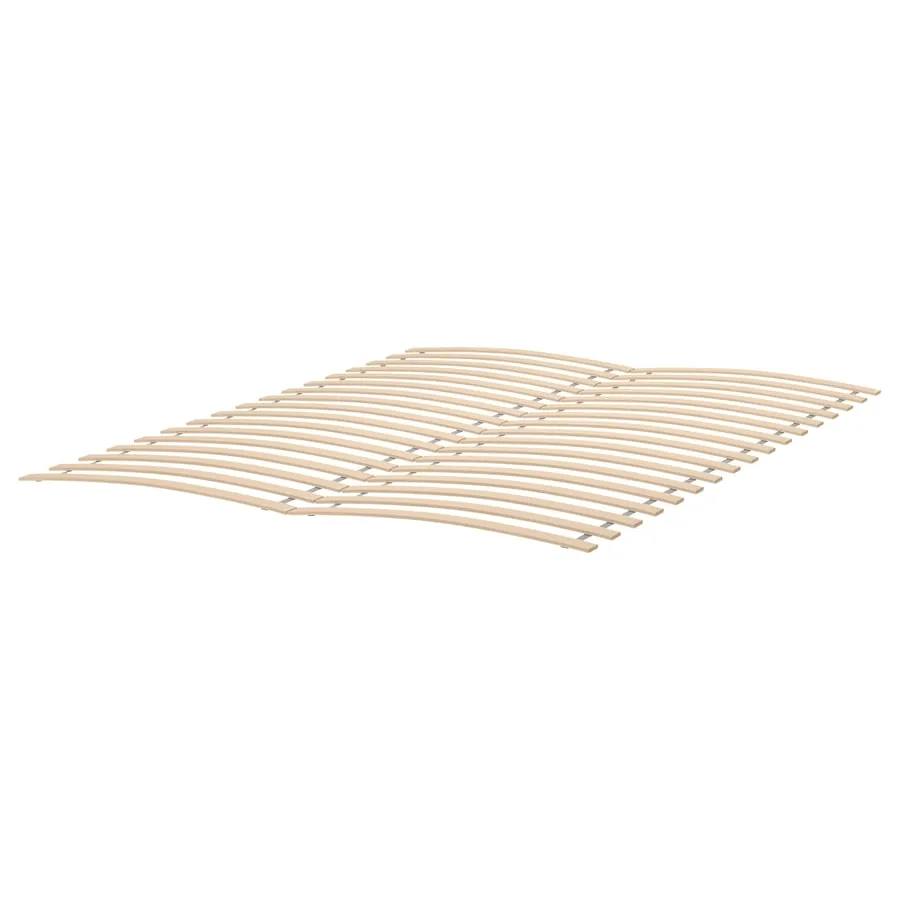
IKEA LURÖY
A$70For an identified base problem, first ask whether an approved part is available. IKEA's Queen LURÖY slatted bed base, article 001.602.15, is A$70. It is a separate curved-slat system, not a complete bed. IKEA says to check the construction when using it with another manufacturer's frame.13 The mattress requirements still apply.
Its published reviews include accounts of slipping slats alongside reports of satisfactory fit. They mix sizes and markets and do not establish an Australian Queen failure rate. They do reinforce the need to check seating and assembly, rather than importing a buyer's improvised fix.
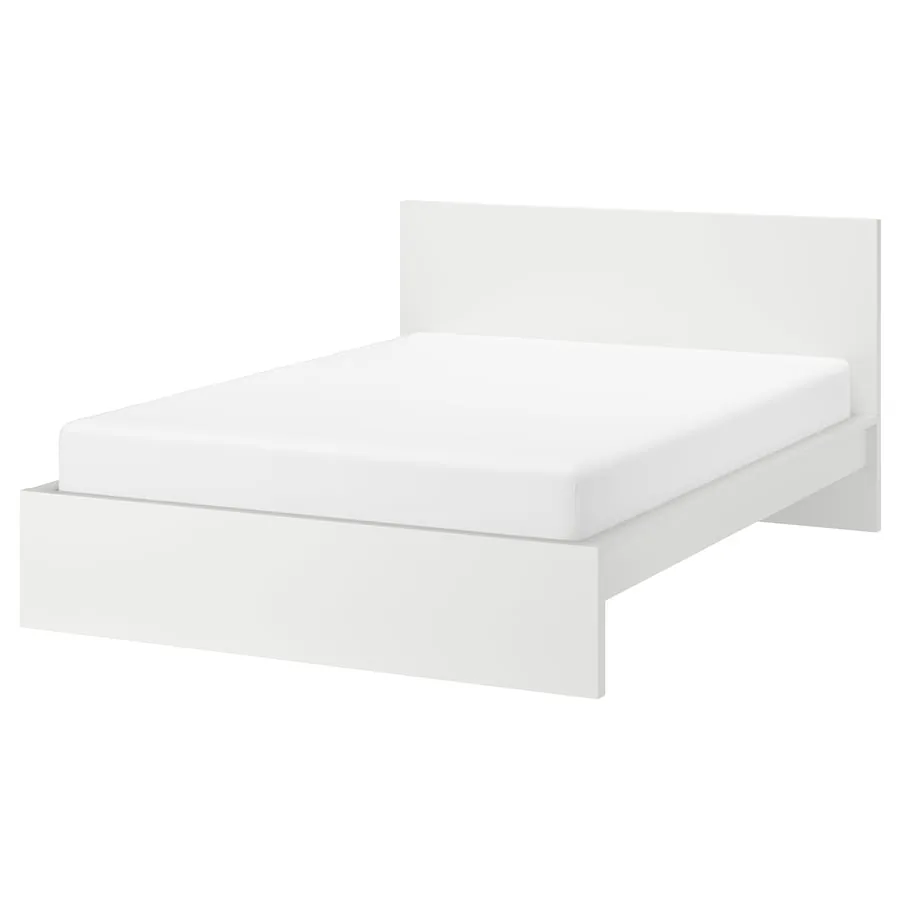
FRAME + SEPARATE SLATS
What does the complete frame cost?
A whole frame adds more components. The white Queen MALM, article 799.316.07, is A$329 including the separately packaged SKORVA midbeam, with slats sold separately. Adding the A$70 LURÖY gives A$399 before delivery or assembly.1314 That calculation is useful only if the resulting arrangement suits the mattress.
DESIGN & CONSTRUCTION
What does the difference buy?

Ecosa Zen

Ecosa Rise
Offer-price difference.
Additional sleep benefit is not established.
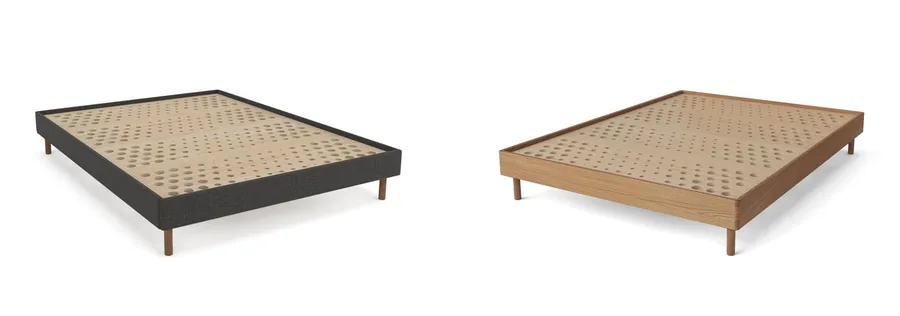
For a different frame or appearance, Ecosa's Queen Ash Zen base is listed at an offer price of A$819, against A$1,170, and its Queen Ash Rise at A$1,428, against A$2,040. Rise adds a headboard with a shelf and adjustable feet.1516 The A$609 offer-price difference buys a different design and construction; the evidence here does not establish A$609 of additional sleep benefit. Confirm dimensions and slat spacing for either before ordering.
SUPPORT CLAIM ≠ COMFORT EVIDENCE
Sleeping Duck
Indestruct Base Only
Sleeping Duck's Indestruct Base Only starts at A$1,349 in its Australian overview, rather than at a verified Queen configuration price. The maker promotes a steel support system and a 2,200 kg capacity.17 That manufacturer claim does not establish comfort or override a mattress's limits. Sleeping Duck's mattress warranty sets a maximum of 140 kg per sleeper.5
The warranty is component-specific: lifetime limited coverage for the steel core, with current terms giving Artisan Skins 12 months. Successful core claims involve sending replacement components for the customer to swap.5 Ask what service work you would need to perform, as well as how the finished configuration reaches your bedroom.
IF THE MATTRESS NEEDS REPLACING
Compare construction on a suitable base.
Ecosa
Original Edition
A$930Offer against A$1,240
Three firmness settings
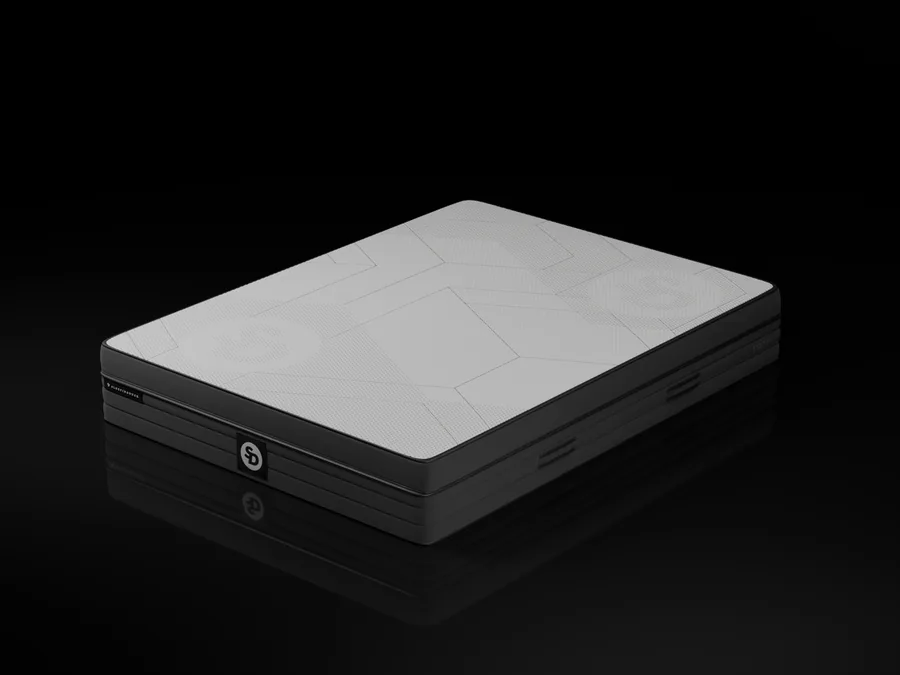
Sleeping Duck Mach II
Foam layers + springs / adjustable foam componentsIf the mattress needs replacing, the foam Queen Ecosa Original Edition is offered at A$930, against A$1,240. The Queen Sleeping Duck Mach II, combining foam layers and springs, is A$1,649. Ecosa offers three firmness settings; Sleeping Duck offers adjustable foam components.1018 Compare those constructions and options on a confirmed suitable base. Neither the price nor adjustability establishes which mattress will suit you or last longer. Check future replacement-component prices and availability before relying on them.
Confirm the complete purchase
Ask for written confirmation of the selected mattress-base combination, with exact models and dimensions. IKEA lists the Queen LURÖY support at 152 × 202 cm, while Sleeping Duck lists its Queen mattress at 153 × 203 cm.1318 The shared size name is not enough to establish fit; a nominal difference is also not an automatic rejection.
Get the full price for the required parts, delivery, assembly and removal. Ecosa lists an optional A$125 mattress collection and recycling service; confirm postcode eligibility and booking conditions before including it in the plan.10
Read the return conditions for the actual product. A mattress sleep trial should not be assumed to cover a separately purchased frame, and a warranty is not a comfort-return policy. Check who organises collection and what happens if a proposed combination proves unsuitable.
Before paying, identify what the purchase changes: a damaged component, an unsuitable base, a mattress requiring replacement or a deliberate comfort preference. If that remains unclear, send the supplier your observations and ask which part needs assessment, and why. A new mattress should follow that answer rather than stand in for it.
“A new mattress should follow that answer rather than stand in for it.”
Sources & notes
Australian sources and listings checked 7 October 2026. Prices are in AUD and may change with offers, configuration, delivery and availability. Product examples illustrate possible measures, not Meleus & Mosman comparative testing. Follow the instructions and terms applicable to your model and purchase.
- 01
- 02
- 03
- 04
- 05
- 06
- 07
- 08
- 09
- 10
- 11
- 12
- 13IKEA Australia: Queen LURÖY slatted bed base, 001.602.15 (opens in a new tab). Published specifications and customer reviews are different forms of evidence.Back to article ↑
- 14
- 15
- 16
- 17
- 18Sleeping Duck Australia: Mach II mattress (opens in a new tab) and Australian size and price options (opens in a new tab).Back to article ↑